
If you are a student or recent graduate staring at a blank resume wondering what to put on it, you are not alone. This is the most common frustration I hear from early-career job seekers: "How do I write a resume when I have no experience?" The short answer is that you have more experience than you think. The long answer is what the rest of this article is about.
Writing a resume for students with no experience requires a strategic shift. You aren't selling your past job titles; you are selling your potential, technical proficiency, and reliability. As a recruiter who has reviewed thousands of entry-level applications, I can tell you that we care more about what you *can do* than what you've *been paid to do*.
1. The Foundation: Contact Information & Professional Branding
Your contact section is the first thing a recruiter sees. It must be clean, professional, and updated. Ensure your email address is professional (e.g., firstname.lastname@email.com) and include a link to your LinkedIn profile or GitHub if you are in a technical field.

2. The Hook: Result-Driven Professional Summaries
The summary is your 6-second elevator pitch. For a student with no experience, this should focus on your academic achievements, core skills, and specific career goals. Avoid generic phrases like "hard worker" or "team player." Instead, use quantifiable wins.
❌ Weak: Highly motivated student seeking an entry-level marketing role to gain experience and help a company grow. ✅ Strong (Result-Driven): Data-driven Marketing senior with 3.9 GPA at State University. Developed a social media campaign for a campus organization that increased event attendance by 45% and grew Instagram following by 800+ in 4 months. Proficient in Google Analytics and Meta Ads.

3. Education: Your Highest Value Credential
When you lack work experience, your education section does the heavy lifting. Place it right at the top. Include your degree, university, expected graduation date, and any academic honors like Dean's List. Don't forget to list Relevant Coursework that aligns with the job you are applying for.

4. The Secret Weapon: Academic & Personal Projects
This is where you prove you can actually do the work. Treat your projects like mini-jobs. Use the Action Verb + Result formula. Did you build an app? Manage a group project? Conduct a scientific study? These are evidence of real-world skills.
Project Sample (Software Engineering): Campus RideShare App | Lead Developer | Jan 2026 • Architected a full-stack mobile application using React Native and Firebase to connect over 1,500 university students for verified carpooling. • Implemented real-time tracking and secure auth flows, resulting in a 40% reduction in reported commute costs for regular users.

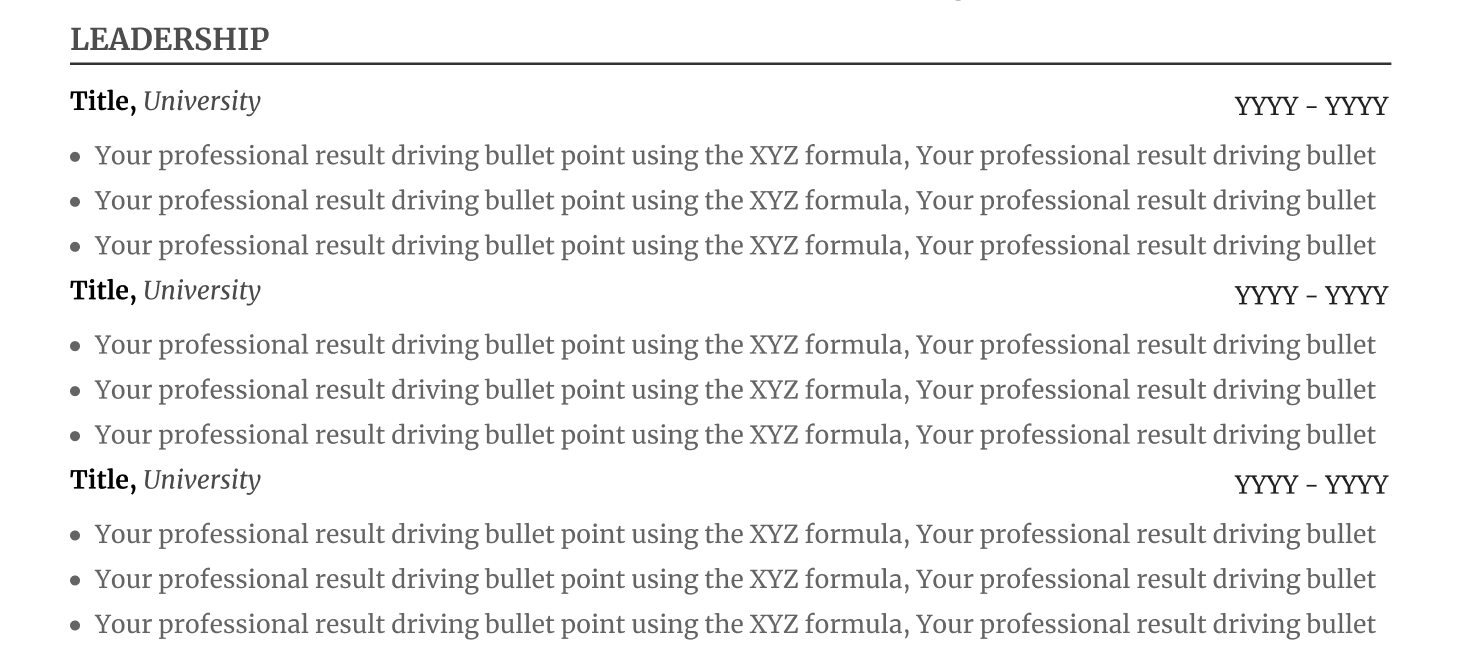
5. Proving Soft Skills: Leadership & Extracurriculars
Employers look for leadership, teamwork, and ownership. Your involvement in student clubs, sports, or volunteer work is the perfect place to show these. If you managed a budget or led a team, say so.
6. Skills & Certifications
Group your skills into logical categories: Technical, Tools, and Soft Skills. For a student, certifications (Google, AWS, Microsoft) are a great way to "hack" your experience section. They provide third-party validation of your abilities.

The Final Result: A Winning Student Resume
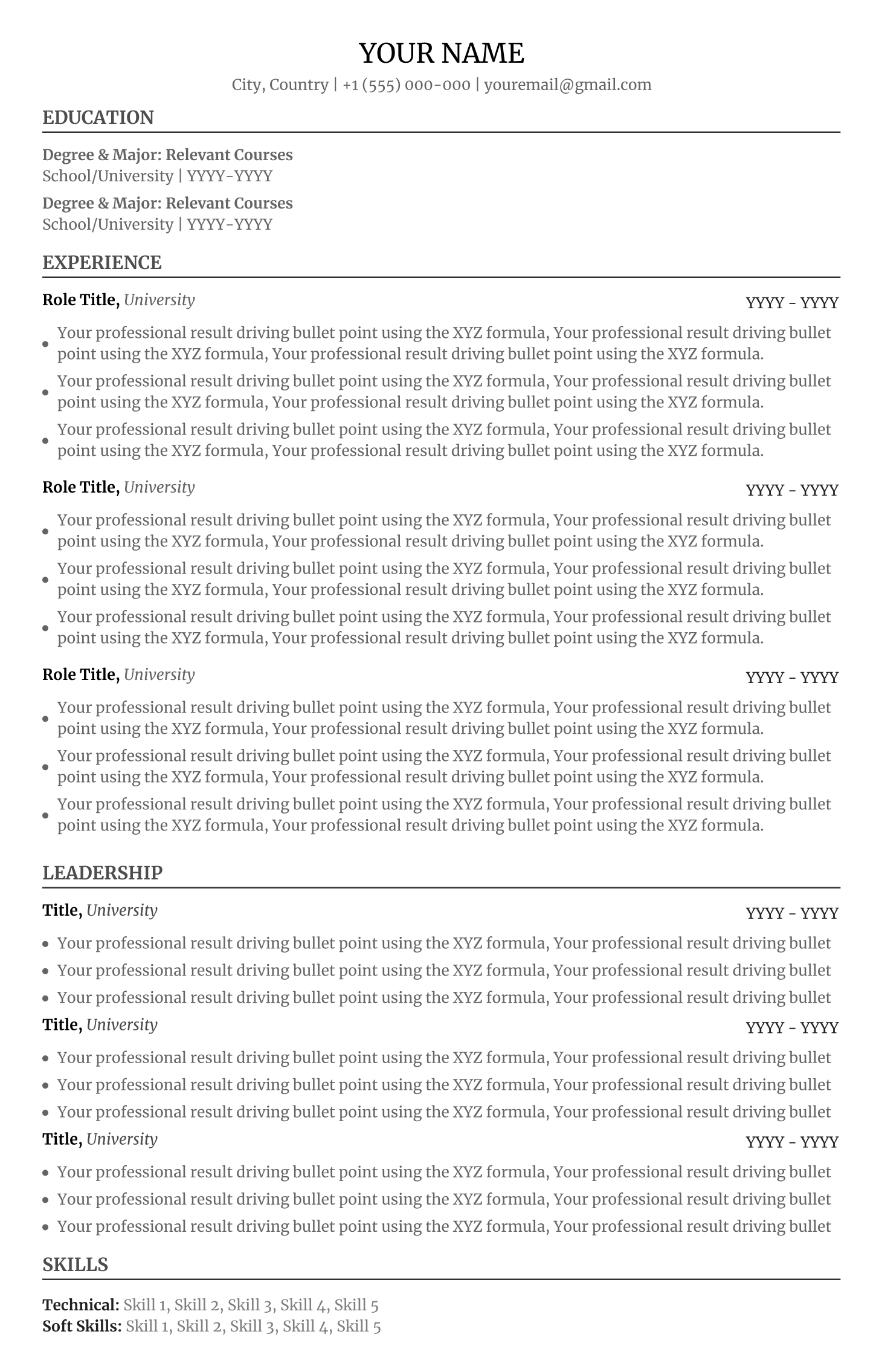
When you bring all these sections together, you get a document that feels authoritative and professional, even without a traditional "Work History" section. Below is a full view of a high-performance student resume.
Alexander Williams
EDUCATION
Bachelor of Science in Electrical Engineering
Boston University
GPA: 3.9/4.0
EXPERIENCE
Hardware Engineering Intern - Analog Devices, Inc., Wilmington, MA
- Designed and tested 4-layer mixed-signal evaluation boards in Altium Designer, validating low-noise analog signal conditioning paths.
- Executed automated signal integrity and power-rail transient ripple measurements using high-bandwidth digital oscilloscopes.
Undergraduate Teaching Assistant (Circuits & Electronics) - Boston University Department of Electrical & Computer Engineering, Boston, MA
- Facilitated weekly hardware lab sessions for 75+ students on AC/DC circuit analysis, op-amp filters, and oscilloscope diagnostics.
- Guided students in schematic capture, SPICE simulation, and hands-on SMD soldering and PCB rework techniques.
PROJECTS
- Engineered motor drive circuitry and sensor interface boards with STM32 ARM Cortex-M4 microcontroller running FreeRTOS.
- Integrated 2D LiDAR scanner and wheel encoders over UART and SPI for real-time obstacle avoidance and indoor SLAM mapping.
- Implemented 8-band configurable FIR digital audio equalizer in Verilog HDL on Xilinx Artix-7 FPGA.
- Interfaced 24-bit I2S audio codec running at 48 kHz sampling frequency, achieving sub-millisecond audio processing latency.
LEADERSHIP
Vice President of Technical Operations - IEEE Student Branch & BU Robotics Team, Boston, MA
- Organized hands-on microelectronics and soldering bootcamps for 150+ undergraduate engineering students.
- Led electrical telemetry hardware design for the university autonomous combat robot team, placing 2nd in regional competition.
SKILLS & INTERESTS
- Hardware & Eda Tools: Altium Designer, KiCad, LTspice, Verilog/Fpga, Matlab/Simulink, Cadence Virtuoso
- Embedded Systems: C/C++, Embedded Linux, Arm Cortex-M (stm32), FreeRTOS, I2c, Spi, Uart, Can Bus
- Lab Instrumentation: Digital Oscilloscopes, Logic Analyzers, Spectrum Analyzers, Signal Generators, Smd Soldering
- Interests: Autonomous Robotics, Digital Signal Processing, Power Electronics, Formula Hybrid
A professional student resume template designed to highlight your potential and academic achievements.
Use This Template