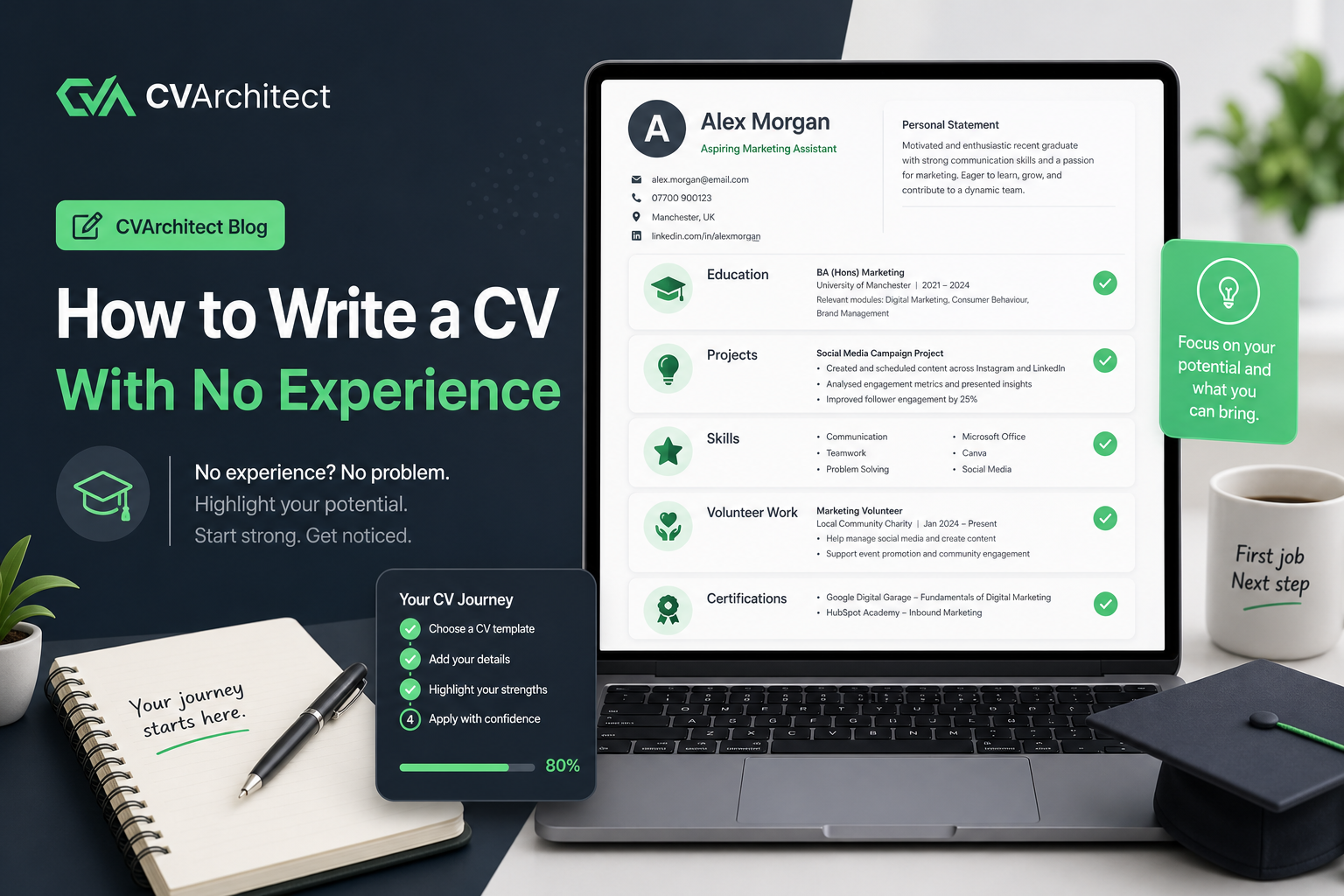
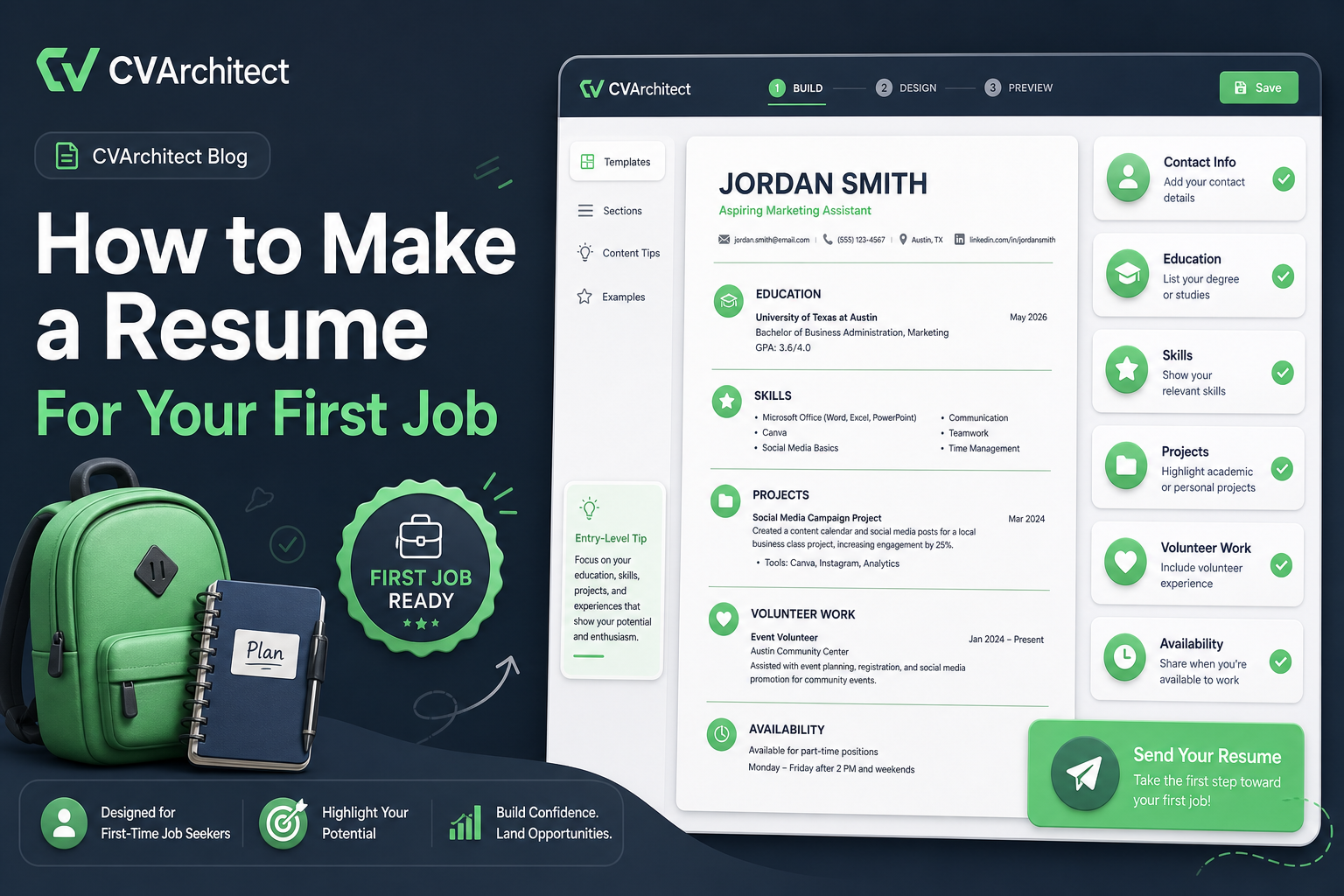
The easiest way to make a resume for your first job is to stop trying to look experienced and start showing that you are reliable, willing to learn, and ready to work. First-job employers do not expect a long job history. They expect a clear resume that proves you can show up, follow instructions, communicate, and handle basic responsibilities.
This guide walks you through every part of a first-job resume: what to include, how to write your first summary, how to use school projects and volunteer work, what skills to add, and how to tailor the resume for jobs like retail, food service, customer service, admin, warehouse, and internships.
What Employers Look for in a First-Job Resume
For a first job, employers usually care less about job titles and more about basic work habits. They want to know whether you are dependable, polite, teachable, and able to handle simple tasks without constant reminders.
- •Can you communicate clearly with customers, coworkers, or supervisors?
- •Can you follow instructions and complete tasks on time?
- •Can you stay organized during busy periods?
- •Can you learn tools, systems, or routines quickly?
- •Can you be trusted with schedules, customers, stock, money, or information?
- •Do you understand the type of job you are applying for?
Your resume should answer those questions. It does not need to be fancy. It needs to be easy to read and specific enough to make you look like a real candidate.
Best Resume Format for a First Job
A first-job resume should usually be one page. Use a simple layout, clear headings, and short bullet points. Do not use a design that hides your information or makes the employer work hard to understand you.
- •Header with your name and contact information
- •Short resume summary
- •Education
- •Skills
- •Projects, coursework, or school activities
- •Volunteer work, clubs, sports, or responsibilities
- •Certifications or training
- •Availability if the job depends on shifts
If this is truly your first job, put education and skills near the top. If you have volunteering, informal work, babysitting, tutoring, family business help, or internships, include them as experience.
Step 1: Write a Clean Header
Your header should make it easy to contact you. Include your full name, phone number, professional email, city or area, and a link only if it helps your application.
- •Good email: firstname.lastname@email.com
- •Avoid: nicknames, jokes, random numbers, or old school emails you may lose access to.
- •Use your city, not your full street address.
- •Add LinkedIn, portfolio, GitHub, or a website only if it is ready for employers to see.
Step 2: Write a First-Job Resume Summary
Your summary should be 2 to 4 lines. It should say what kind of role you want and what useful strengths you bring. Do not start with "I have no experience." Start with what you can offer.
First-job resume summary examples
- •Retail: "Friendly and reliable student seeking a part-time retail assistant role. Strong communication skills, comfortable helping people, and available evenings and weekends."
- •Food service: "Hardworking entry-level candidate looking for a restaurant or cafe role. Able to work in a fast-paced environment, follow instructions, and support a clean and organized workspace."
- •Office: "Organized recent graduate seeking an entry-level office assistant role. Comfortable using Microsoft Word, Excel, Google Docs, and email, with strong attention to detail from coursework and group projects."
- •Customer service: "Patient and helpful first-job applicant with strong listening skills and a calm approach to problem-solving. Looking for a customer-facing role where I can learn quickly and support a team."
Step 3: Add Education the Right Way
For a first job, education is important because it may be your strongest proof of effort and discipline. Add your school, course, dates, expected graduation if relevant, and subjects that connect to the job.
- •For retail or customer service: mention business, communication, English, maths, media, or any customer-related coursework.
- •For office jobs: mention IT, business, administration, accounting, writing, or research-heavy coursework.
- •For food service: mention hospitality, food safety, health, teamwork, or practical subjects.
- •For internships: mention modules, research, projects, software, and presentations.
Example: "A-Level Business Studies, English Language, and Mathematics. Completed a group business plan project, including market research, cost estimates, and a 10-slide presentation."
Step 4: Turn School Projects Into Resume Experience
Projects are useful because they show work. They prove you can complete something, solve a problem, or present an idea. A project does not need to be paid to be valuable.
- •Business project: researched 5 local competitors and presented pricing ideas to a class group.
- •Design project: created 12 Canva graphics for a mock social media campaign.
- •Technology project: built a 5-page website using HTML and CSS.
- •Community project: helped organize registration and seating for an event with 150 attendees.
- •Research project: collected survey responses from 40 students and summarized findings in a report.
Write projects like mini experience entries. Include what you did, who it was for, tools used, and what came out of it.
Step 5: Choose Skills That Match the Job
Do not add every skill you can think of. Pick skills that match the job advert. If the advert says "friendly customer service," "cash handling," "stocking shelves," and "weekend availability," your resume should speak to those things if they are true.
- •Retail skills: customer service, product knowledge, stock organization, POS awareness, communication, teamwork.
- •Food service skills: food safety awareness, cleaning standards, order taking, teamwork, working under pressure.
- •Office skills: Microsoft Office, Google Workspace, data entry, email writing, scheduling, file organization.
- •Warehouse skills: order picking, inventory support, health and safety awareness, accuracy, physical stamina.
- •Internship skills: research, writing, Excel, presentations, project coordination, problem-solving.
Step 6: Add Volunteer Work, Activities, or Informal Experience
If you have helped anywhere, include it. Volunteer work, clubs, sports teams, family business support, babysitting, tutoring, church activities, community events, and school leadership can all show employability.
- •Babysitting: cared for 2 children after school, helped with homework, prepared snacks, and followed family routines.
- •Family business: helped pack orders, greet customers, update stock lists, or clean work areas.
- •Sports team: attended weekly training, supported team communication, and helped younger players learn drills.
- •Volunteer event: welcomed guests, answered questions, helped with setup, and supported cleanup.
- •School club: helped plan meetings, create posters, manage sign-ups, or present updates.
Step 7: Use Simple Metrics That Prove Scale
You do not need corporate numbers for a first-job resume. You just need details that make your examples real. Numbers help employers understand the size of what you did.
- •People: "helped 30 students," "welcomed 100 guests," "worked in a 5-person group."
- •Time: "volunteered 3 hours every Saturday," "completed a 6-week project," "met weekly deadlines."
- •Output: "created 12 posters," "wrote 8 product descriptions," "built a 5-page website."
- •Responsibility: "handled registration for 150 attendees," "organized 80 donated items," "tracked 40 research sources."
- •Availability: "available 20 hours per week," "available evenings and weekends."
Example: "Helped set up and run a school fundraising stall for 200 students, organizing products, answering questions, and keeping the table stocked during lunch break."
First Job Resume Example: Retail Assistant
- •Summary: "Friendly student seeking a part-time retail assistant role with evening and weekend availability."
- •Skill focus: communication, stock organization, customer service, teamwork, reliability.
- •Experience example: "Helped run a school fundraising stall for 200 students, greeting visitors, organizing stock, and answering product questions."
- •Education detail: "Completed Business Studies project researching pricing and customer behavior for local shops."
First Job Resume Example: Food Service
- •Summary: "Reliable entry-level candidate looking for a cafe or restaurant role. Comfortable working in a busy team and following cleaning and service routines."
- •Skill focus: teamwork, cleaning standards, order accuracy, communication, working under pressure.
- •Experience example: "Supported community event refreshments table for 120 guests, restocking cups and snacks, keeping the area clean, and helping visitors find what they needed."
- •Extra detail: "Available weekends and school holidays."
First Job Resume Example: Office Assistant
- •Summary: "Organized recent graduate seeking an entry-level office assistant role with strong computer and communication skills."
- •Skill focus: Microsoft Word, Excel, Google Docs, email writing, file organization, data entry.
- •Project example: "Created a shared spreadsheet for a 5-person research project, tracking 40 sources, task owners, and deadlines."
- •Education detail: "Completed coursework requiring reports, presentations, and independent research."
First Job Resume Example: Internship
Internship resumes should show curiosity, relevant coursework, projects, and tools. Employers do not expect you to know everything. They want signs that you can learn quickly and contribute to basic tasks.
- •Summary: "Marketing student seeking an internship where I can support research, content planning, and campaign reporting."
- •Project example: "Created a 4-week content plan for a mock product launch, including 16 social posts, audience research, and a campaign calendar."
- •Skill focus: research, writing, Canva, Excel, Google Analytics basics, communication.
- •Portfolio: include a link if you have samples.
How Long Should a First-Job Resume Be?
One page is enough for almost every first-job resume. If your resume is two pages and you have no formal experience, it probably includes too much explanation. Keep it clear and useful.
- •Use short paragraphs or bullet points.
- •Remove repeated skills.
- •Keep the summary under 4 lines.
- •Use 2-4 bullets for projects or activities.
- •Only include hobbies if they support the job or show responsibility.
How to Make Your Resume ATS Friendly
Many first-job applications still go through online systems. Use an ATS-friendly resume template so the system can read your name, contact details, education, skills, and experience.
- •Use standard headings: Summary, Education, Skills, Projects, Volunteer Work, Certifications.
- •Avoid putting contact details inside icons only.
- •Avoid large tables, text boxes, and heavy graphics.
- •Use words from the job advert naturally.
- •Save as PDF unless the employer asks for another format.
- •Check the file name: Firstname-Lastname-Resume.pdf is better than resume-final-final2.pdf.
Should You Use a Simple Resume Maker?
A simple resume maker can help you move faster, especially if you are not sure where each section should go. A good job resume maker should give you a clean layout, help you organize first-job details, and let you edit the resume for each application.
The tool should not make your resume sound fake. Keep your words honest. Use the builder to structure your information, not to pretend you have experience you do not have.
Common First-Job Resume Mistakes
- •Starting with "I have no experience."
- •Using a messy email address.
- •Leaving out projects, volunteering, activities, or informal work.
- •Writing long paragraphs instead of clear bullet points.
- •Adding too many unrelated hobbies.
- •Using the same resume for every job.
- •Listing skills you cannot explain.
- •Forgetting availability for shift-based jobs.
- •Submitting without checking spelling and contact details.
Direct Answer: How Do You Make a Resume for Your First Job?
To make a resume for your first job, use a one-page layout with your contact details, a short summary, education, relevant skills, projects, volunteer work, activities, certifications, and availability. Focus on proof that you are reliable, teachable, organized, and ready to work. Use examples from school, volunteering, family responsibilities, clubs, and personal projects if you do not have paid experience.
Final Checklist Before You Send It
- •Is the resume one page?
- •Does the summary match the job?
- •Did you include education and relevant skills?
- •Did you add projects, volunteering, activities, or informal responsibilities?
- •Did you use simple numbers to show scale or output?
- •Did you include availability if it matters?
- •Is the layout clean and ATS friendly?
- •Did you proofread it carefully?
Final Advice
Your first-job resume does not need to be perfect. It needs to be clear, honest, and targeted. Employers hiring for entry-level roles are not looking for a finished professional. They are looking for someone they can trust to learn, show up, and do the work.
Start with what you have. Education, projects, volunteering, activities, skills, and reliability all count. Put them in a simple format, tailor the resume to the job, and send it with confidence.
Alexander Williams
EDUCATION
Bachelor of Science in Electrical Engineering
Boston University
GPA: 3.9/4.0
EXPERIENCE
Hardware Engineering Intern - Analog Devices, Inc., Wilmington, MA
- Designed and tested 4-layer mixed-signal evaluation boards in Altium Designer, validating low-noise analog signal conditioning paths.
- Executed automated signal integrity and power-rail transient ripple measurements using high-bandwidth digital oscilloscopes.
Undergraduate Teaching Assistant (Circuits & Electronics) - Boston University Department of Electrical & Computer Engineering, Boston, MA
- Facilitated weekly hardware lab sessions for 75+ students on AC/DC circuit analysis, op-amp filters, and oscilloscope diagnostics.
- Guided students in schematic capture, SPICE simulation, and hands-on SMD soldering and PCB rework techniques.
PROJECTS
- Engineered motor drive circuitry and sensor interface boards with STM32 ARM Cortex-M4 microcontroller running FreeRTOS.
- Integrated 2D LiDAR scanner and wheel encoders over UART and SPI for real-time obstacle avoidance and indoor SLAM mapping.
- Implemented 8-band configurable FIR digital audio equalizer in Verilog HDL on Xilinx Artix-7 FPGA.
- Interfaced 24-bit I2S audio codec running at 48 kHz sampling frequency, achieving sub-millisecond audio processing latency.
LEADERSHIP
Vice President of Technical Operations - IEEE Student Branch & BU Robotics Team, Boston, MA
- Organized hands-on microelectronics and soldering bootcamps for 150+ undergraduate engineering students.
- Led electrical telemetry hardware design for the university autonomous combat robot team, placing 2nd in regional competition.
SKILLS & INTERESTS
- Hardware & Eda Tools: Altium Designer, KiCad, LTspice, Verilog/Fpga, Matlab/Simulink, Cadence Virtuoso
- Embedded Systems: C/C++, Embedded Linux, Arm Cortex-M (stm32), FreeRTOS, I2c, Spi, Uart, Can Bus
- Lab Instrumentation: Digital Oscilloscopes, Logic Analyzers, Spectrum Analyzers, Signal Generators, Smd Soldering
- Interests: Autonomous Robotics, Digital Signal Processing, Power Electronics, Formula Hybrid
Make your first-job resume with a clean, beginner-friendly template built for education, skills, projects, and early experience.
Use This Template