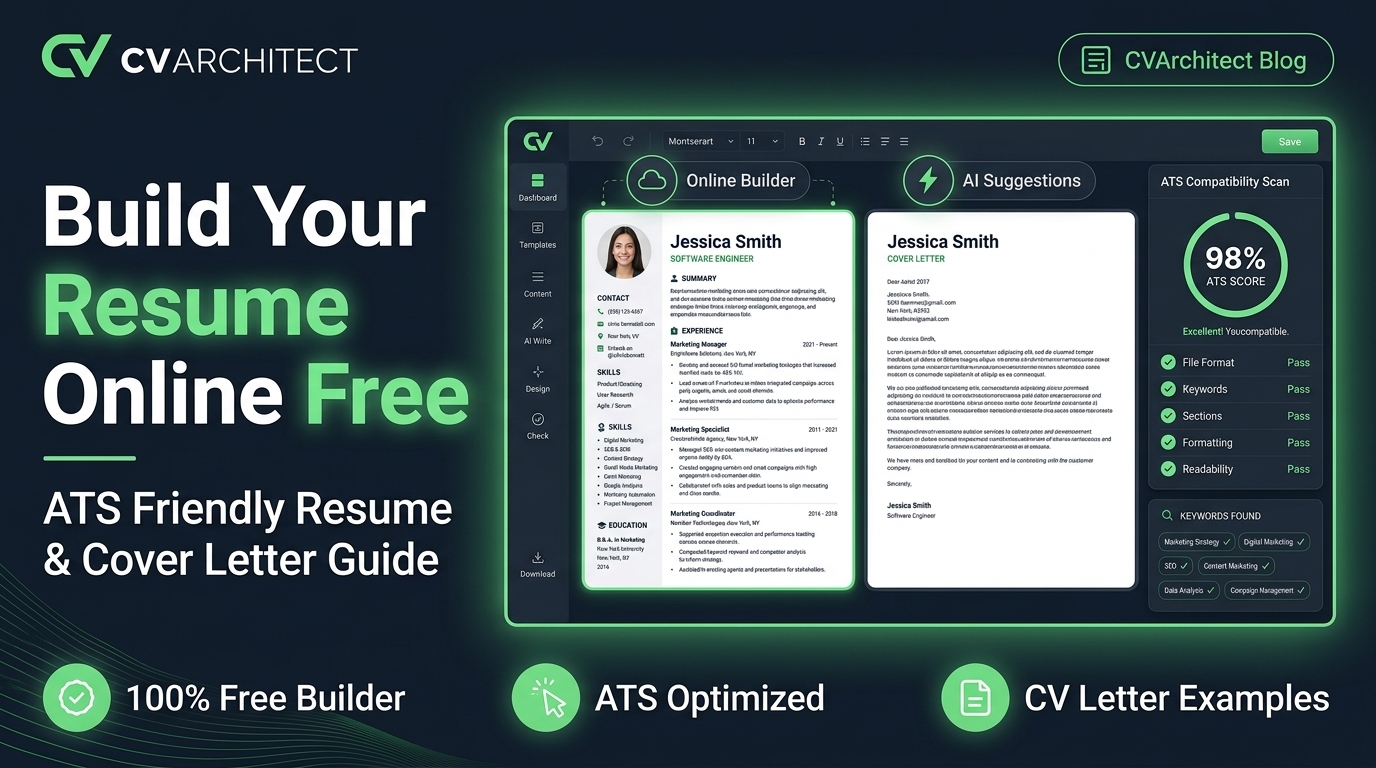
Most job seekers still treat resume writing like a formatting task. Pick a template, list job duties, export PDF, apply everywhere. Then nothing happens. If that sounds familiar, the problem is usually not your experience. The problem is strategy.
In 2026, you need to build your resume for two audiences at once: the ATS parser that scores relevance and the recruiter who scans for impact. A polished document that fails ATS never gets seen. An ATS-heavy document with weak storytelling gets ignored by hiring managers.
Why "Build Your Resume" Is a High-Intent Search
When someone searches "build your resume," they are not looking for theory. They are actively trying to get interview-ready quickly. They need structure, examples, and confidence that their resume can survive real hiring workflows.
That is why this guide focuses on execution. You will learn how to choose an ATS friendly resume template, write achievement bullets with meaningful metrics, and tailor each version for specific roles without starting from scratch every time.
What Is an ATS Friendly Resume Template?
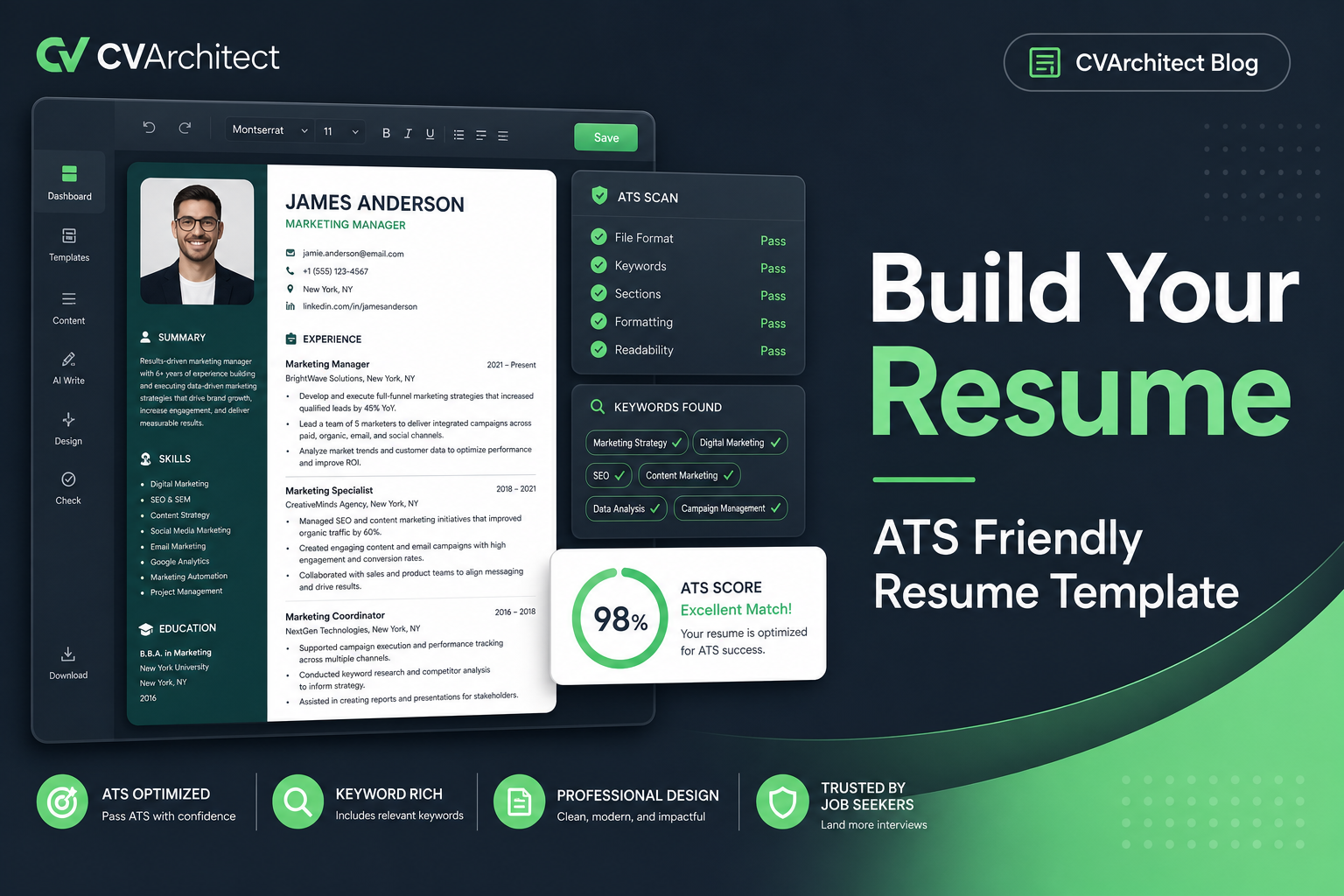
An ATS friendly resume template is a layout that can be parsed cleanly by applicant tracking systems while still being easy for recruiters to read in under 10 seconds. It prioritizes information architecture over decoration.
- •Uses clear section headings like Summary, Experience, Education, and Skills.
- •Avoids text in images, complex tables, and layered columns that confuse parsers.
- •Keeps typography simple and readable with consistent spacing.
- •Preserves chronology and role titles in standard formats.
- •Supports keyword relevance without keyword stuffing.
If a template looks beautiful but forces you into visual tricks, it is not ATS-friendly. Prioritize parseability first, then design quality.
Step 1: Pick One Target Role Before You Write Anything
The fastest way to weaken a resume is trying to make one version fit five different role types. A recruiter should immediately understand what role you are targeting from your title, summary, and first three experience bullets.
Start by selecting one role family. Example: "Product Marketing Manager" instead of the vague "marketing professional." Then collect 8-12 recent job descriptions and extract repeated skills, tools, and business outcomes.
Step 2: Build Your Resume Around Outcomes, Not Duties
Most resumes fail because they describe responsibilities, not results. Hiring teams already know what a role generally does. They care about what changed because you were there.
Use this bullet formula
Action + Scope + Business Metric
- •Weak: "Responsible for email marketing campaigns."
- •Strong: "Launched lifecycle email campaigns across 4 customer segments, generating 1,850 qualified trial activations and recovering $420K in expansion pipeline in one quarter."
- •Weak: "Managed sales reports."
- •Strong: "Built weekly pipeline dashboards in Salesforce and Looker for a $12M sales pipeline, reducing manual reporting time by 6 hours per week and giving 14 account executives real-time deal visibility."
What Counts as a Good Resume Metric?
Percentages can be useful, but they are often weaker than concrete metrics when they appear alone. "Improved efficiency by 20%" sounds nice, but it leaves the reader asking: 20% of what? How much money, time, volume, risk, or customer impact was involved?
Good resume metrics make the scale of your work obvious. They help recruiters understand the size of the problem, the resources involved, and the business value created.
- •Revenue and pipeline: "$1.8M new ARR," "$420K expansion pipeline," "$75K monthly recurring revenue protected."
- •Cost and savings: "$180K annual vendor savings," "$42K in recovered overpayments," "$12K monthly cloud spend reduction."
- •Time and speed: "reduced close process from 10 days to 4 days," "saved 6 hours per week," "cut onboarding time from 30 days to 14 days."
- •Volume and scale: "supported 1,200 employees," "processed 45K monthly invoices," "handled 500K API requests per day."
- •Quality and reliability: "zero audit findings," "no P1 incidents across 12 months," "all priority tickets resolved within SLA targets."
- •Leadership scope: "managed 8 analysts," "trained 35 new hires," "owned reporting for 4 regional teams."
Use percentages only when they clarify a real business result. A stronger bullet leads with the concrete metric: "saved 14 hours per week across a 9-person operations team by redesigning invoice processing."
Step 3: Write a Summary That Positions You in 4 Lines
Your summary should act like a strategic headline, not a personal statement. Mention your years of experience, core specialization, industry context, and quantified strengths.
Example: "Growth-focused operations leader with 9+ years scaling systems across SaaS and e-commerce teams. Built cross-functional workflows for 4 regional teams, saving 120+ staff hours per month and improving on-time delivery across a $6.5M fulfillment operation. Expert in process design, KPI governance, and team enablement."
Step 4: Make Keyword Matching Intentional
ATS matching is largely a relevance game. If the job description emphasizes stakeholder management, forecasting, SQL, and dashboarding, those concepts should appear naturally in your summary, skills, and achievement bullets.
Do not copy-paste the entire posting. Mirror important terminology where it is true for your background. Natural placement beats brute-force keyword stuffing every time.
Step 5: Use an Online Resume Builder to Scale Tailoring
A good online resume builder does more than give you templates. It helps you maintain clean formatting, preserve ATS compatibility, and duplicate versions quickly for different applications.
- •Keep one master resume with your full achievement inventory.
- •Duplicate by role target (e.g., PMM, Growth Marketing, RevOps).
- •Swap top summary and first bullets to match each posting.
- •Adjust skills ordering based on job-specific priority.
- •Export cleanly without broken spacing or hidden text.
Where Professional Resume Writing Services Fit
If you are repeatedly applying and getting zero callbacks, outside expertise can be worth it. Professional resume writing services are most useful when your challenge is positioning, not effort.
For senior leaders, executive resume writing services can help craft board-level narrative, transformation impact, and leadership scope in a way most DIY resumes miss. Executive hiring is as much about strategic framing as it is about credentials.
Whether you use a writer or do it yourself, require ATS-safe formatting and quantifiable business outcomes. Those two factors are non-negotiable.
Common Mistakes That Kill Response Rates
- •Using one generic resume for every role.
- •Writing long paragraphs instead of scannable bullets.
- •Listing tools without proving business impact.
- •Choosing design-heavy templates that break ATS parsing.
- •Skipping concrete metrics such as revenue, cost savings, time saved, volume handled, team size, SLA quality, or customer/account scope.
- •Leaving summary sections vague and interchangeable.
A Practical Quality Check Before You Apply
- •Can a recruiter identify your target role in 5 seconds?
- •Does each recent role include concrete metrics, not just vague percentages?
- •Does your language match core terms from the job posting?
- •Is your template ATS-friendly and visually clean?
- •Is your top third (summary + first bullets) role-specific?
- •Would this resume still be readable if printed in plain black and white?
Final Takeaway
If your goal is more interviews, stop treating your resume like a static document. Build your resume like a conversion asset: targeted, measurable, and easy to parse. Start with an ATS friendly resume template, tailor for each role, and use an online resume builder to move faster without breaking structure.
The market rewards clarity and relevance. When your resume proves both, callbacks follow.
William Clarkson
EDUCATION
EXPERIENCE
- Conducted monthly financial analysis to identify variances and trends, resulting in a 10% reduction in unnecessary expenses.
- Assisted in the preparation of quarterly financial statements, ensuring accuracy and compliance with regulatory standards.
- Implemented new accounting software, resulting in a 20% increase in efficiency in financial reporting processes.
- Managed accounts payable and accounts receivable functions, reducing outstanding balances by 15% within six months.
- Reconciled bank statements and resolved discrepancies, leading to a 98% accuracy rate in financial records.
- Assisted senior accountants in preparing tax returns for clients, resulting in a 20% decrease in errors compared to the previous year.
- Conducted audits of financial transactions to ensure compliance with internal policies and regulatory requirements.
- Provided support in month-end closing activities, including journal entries and balance sheet reconciliations.
SKILLS & INTERESTS
- Account Monitoring, Financial Modeling, Tax Planning, Accounts Payable, Cost Accounting, Financial Reporting, Account Analysis, Account Reconciliation, Financial Analysis, Accounts Receivable, Invoicing, Payroll, Auditing, Excel, QuickBooks, Organizational Skills, Problem-Solving, Communication Skills, Generally Accepted Accounting Principles (gaap), Analytical Skills, Data Visualization, Adp Workforce Now, Expensify
Ready to build your resume with ATS-safe structure and faster tailoring? Start with CVArchitect and create your first optimized version in minutes.
Use This Template